
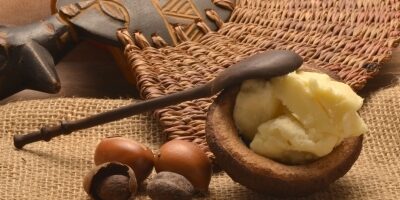
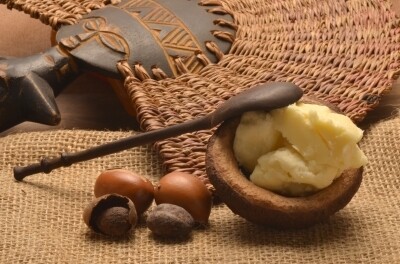
Ghana, Africa
How is it produced?
Shea butter is produced from the nuts of shea trees which are indigenous to the savannah regions of Africa (Adedeji et al., 2024). Due to its versatility, shea butter has become a major commodity in global markets and throughout Africa shea resources generate income for millions of rural African women and their households (Naangmenyele et al., 2023). For shea butter production, the major inputs are shea kernels, water, fuel, and labor, while the major outputs are shea butter, wastewater and shea residue (Naangmenyele et al., 2023).
In Africa, shea butter production relies on a mix of manual, semi-mechanized, and automated processes, which include gathering shea nuts, making shea butter, commodity marketing and distribution (Naangmenyele et al., 2023). After the shea nuts have been gathered, they are sorted, washed and left to dry before being crushed and roasted (Naangmenyele et al., 2023). After roasting the crushed nuts are milled into a paste and then kneaded, which involves keeping a consistent rhythm going while intermittently adding water (Naangmenyele et al., 2023). Then the crude butter is boiled to separate the yellow oil from the brown residue and left to cool before it is filtered; after filtering it is left to cool again until it becomes semi-solid (Naangmenyele et al., 2023). When the shea butter is in a semi-solid state it is packaged in a plastic bag within a box before it becomes solidified so that it takes the shape of the packaging (Naangmenyele et al., 2023).
Describe the supply chain to the store shelf in Canada:
The versatility of shea butter means it can infiltrate multiple markets, and its movement is anything but linear (Chalfin, 2004). There are over twenty reported uses of shea butter, but overall, most shea circulates out of Africa as nuts or butter and returns as “cheap chocolate and fancy cosmetics” (Chalfin, 2004, p. 176). In 2025, the global shea butter market was reportedly worth over 2 billion USD and is estimated to grow to over 5 billion USD by 2035 (EMR, 2026). Since shea has become the leading source of CBS (cocoa butter substitute), its circulation is perpetuated through multiple global structures, such as COPAL (Cocoa Producers Alliance) members, various EU bodies, and multinational corporations (Chalfin, 2004). According to the Global Shea Alliance (GSA), of the shea nuts harvested, 90% goes to traders and 10% goes to village-based processors within Africa (GSA, 2026). Of the quota allotted to traders, 45% of nuts go to international mechanical processors and 45% goes to African mechanical processors (GSA, 2026). Of the African mechanically processed shea butter, 30% is sent to international refiners and fractionators, while 15% goes to African fractionators (GSA, 2026). Of the 45% of shea nuts that go to international mechanical processors, 70% goes to international refineries and 5% goes to international fractionators (GSA, 2026). Finally, 90% of the refined or fractionated shea butter goes to edible brands while 10% goes to cosmetic brands (GSA, 2026).
The position of shea in the chocolate market converges with the cosmetics market because the three major companies that command the market for shea nuts are the same companies which dominate the market for CBS (Chalfin, 2004). These three established firms are Karlshamns (Swedish), Aahus Olie (Danish), and Loders Croklaan (Chalfin, 2004). The low price of shea nuts allows companies to keep CBS at a low price, which gives them more leverage in the chocolate/confection market (Chalfin, 2004). Currently, the largest producer of shea destined for the chocolate market is Europe, which import approximately 250,000 tonnes annually (Morrison, 2020). Shea enhances the melting point, stability and texture of many packaged food commodities and has become a coveted alternative to cocoa butter (Morrison, 2020).
The dominance of a few large firms in shea production and export also has significant impacts on the cosmetics market (Chalfin, 2004). The leading firms claim that cosmetic shea butter must be industrially refined to meet consumer standards, and the resulting products are ultra processed and contain barely any shea (Chalfin, 2004). Despite this, shea butter is consistently advertised as a wholesome alternative to corporate mainstream products, and is typically marketed by niche companies, such as The Body Shop (Chalfin, 2004). By appealing to consumers opposed to mass-marketed commodities, smaller companies have profited by using shea to create customized artisanal products (Chalfin, 2004). However, big brands often exploit this market by deceiving consumers, such as the Origins line, which sells a large range of shea products separate from their other products branded by the corporate giant, Estee Lauder (Chalfin, 2004).
What is the power balance between the producer and seller?
There are a multitude of power dynamics and inequalities in all aspects of shea production and marketing. Those collecting shea nuts face on-site dangers as well as transportation issues and access rights to shea trees (Adedeji et al., 2024). In certain areas, kidnapping, thievery, and terrorism have emerged as growing threats for those harvesting shea nuts (Adedeji et al., 2024). Approximately 800,000 tonnes of African shea nuts are collected annually, mostly by rural African women (Morrison, 2020). The logistics of collecting and transporting shea nuts is significant since many manufacturers buy shea nuts rather than butter because it is cheaper and allows them more control over processing (Adedeji et al., 2024). This strategy threatens to take all the employment and revenue generated through shea production away from the African economy and place all the profit in the hands of huge, foreign corporations. Only a small amount of shea is processed within Africa, which is detrimental to rural economies, where most processing is done by women who typically finance their businesses by using their savings, while relying on extension agents for guidance (Adedeji et al., 2024). Whether the means of production are mechanized or manual, African women’s wages are meager in relation to the value of the finished product, while foreign corporations make millions in the industry. African marketers face significant barriers to success, such as the lack of standardized measurement systems, insufficient storage spaces and transportation infrastructures, high overhead costs and running expenses, lack of operational training, limited credit access, and unstable market prices (Adedeji et al., 2024).
Can you recommend changes to the system to improve the balance?
There are many ways that inequalities in the shea trade could be improved. Women engaged in the production of shea butter should be supported by governments and NGOs who should invest in decent production facilities, industry training and enterprise startups to ensure that women are not just pouring their own money into starting up their businesses. Economic sustainability can be improved by ensuring fair wages and promoting sustainable production methods, such as investing in better technology to make processes quicker, safer and environmentally sustainable. To improve marketing, steps should be taken to implement standardized measures of quality control and product certification, and ease credit access (Adedeji et al., 2024). Progress is being made through industry associations such as the GSA (a non-profit with over 800 members), which advocates for sustainability, standardized practices and quality control (GSA, 2026). In terms of worker safety, the Solidaridad organization, along with partners (including The Body Shop, and the Global Shea Alliance) has implemented workshops and systems to ensure better health and safety standards for women harvesting shea nuts (Solidaridad, 2023).
References/Resources:
Adedeji, A. et al. (2024). Shea butter (Vitellaria paradoxa G.) production in Nigeria: Constraints and prospects a multifaceted industry in the 21st century. https://ieeexplore.ieee.org/document/10629804
Chalfin, B. (2004). Chocolate Wars and Cosmetics Contests. Shea Butter Republic: State Power, Global Markets, and the Making of an Indigenous Commodity. Taylor & Francis Group. https://ebookcentral.proquest.com/lib/trulibrary-ebooks/detail.action?docID=182829
Expert Market Research (EMR). (2026). Shea Butter Market Report Snapshots. https://www.expertmarketresearch.com/reports/shea-butter-market/companies
Global Shea Alliance (GSA). (2026). Industry Overview. https://www.globalshea.com/overview?page=MjkwMzA1NjI0LjE0MTU=/Industry%20Overview
Morrison, O. (2020). Shea growers celebrate latest US green light. Confectionary News. https://www.confectionerynews.com/Article/2020/12/21/Shea-growers-celebrate-latest-US-green-light/
Naangmenyele, Z. et al. (2023). Fundamentals of Shea butter production; input-output analyses and profit maximization in Northern Ghana. https://www.sciencedirect.com/science/article/pii/S2590051X23000035
Solidaridad. (2023). Improving health and safety with shea nut collectors. Solidaridad. https://www.solidaridadnetwork.org/news/improving-health-and-safety-with-shea-fruit-collectors/