
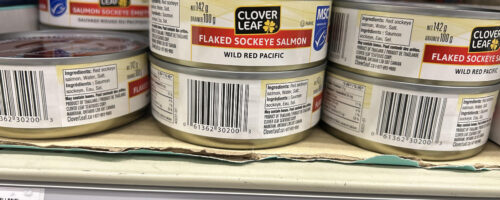
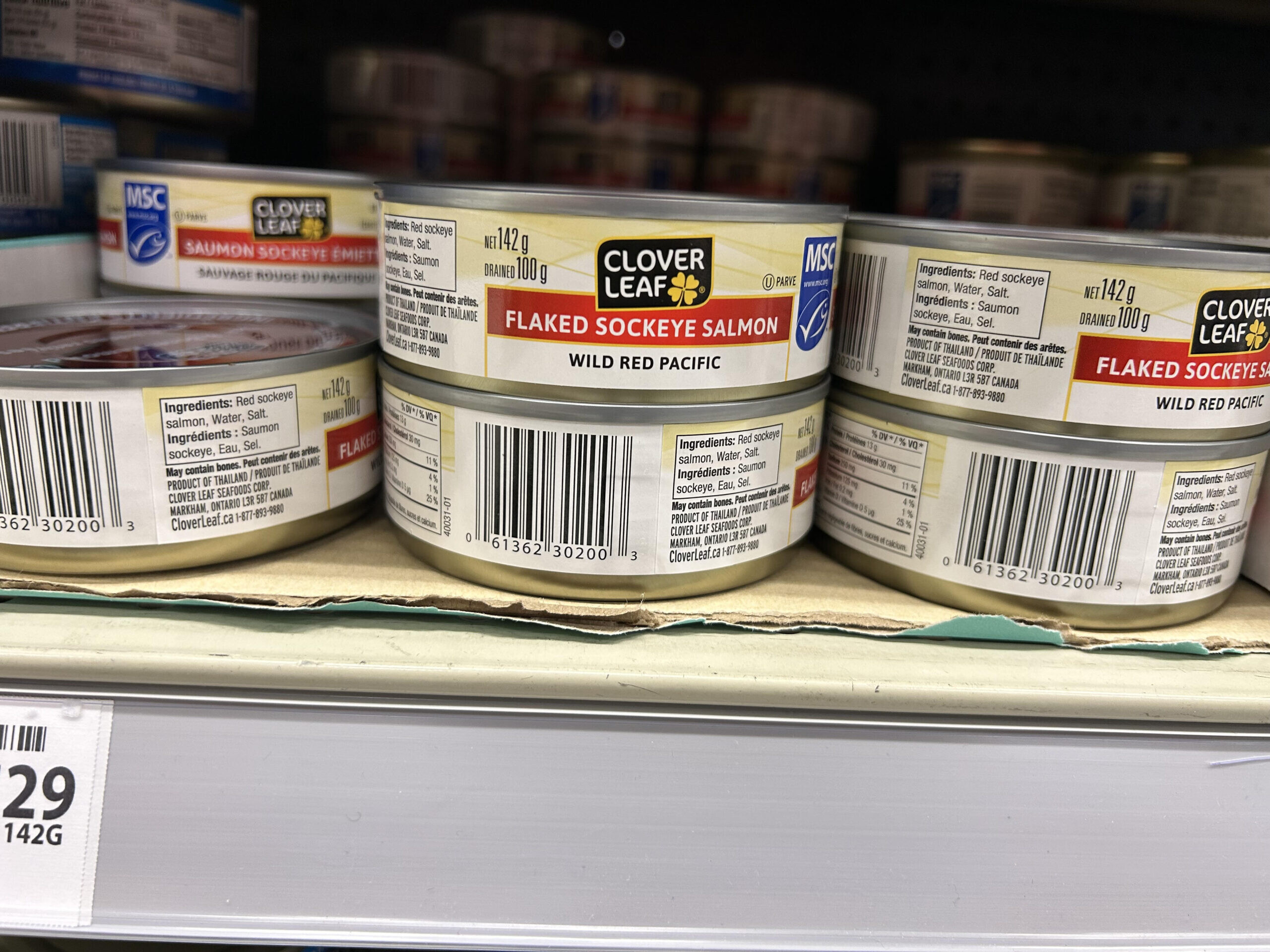
Prince Rupert BC
How is it produced?
It is caught by fishers off the northern coast of BC without consent of Indigenous people who historically have protected rights to fishing. It is then Frozen and exported to Thailand.
Describe the supply chain to the store shelf in Canada:
Frozen salmon that is exported at low cost to Thai processing facilities where labour is cheap and laws are weak. These facilities are linked to many human rights issues like unpaid work and dangerous conditions. It is canned and then shipped back to Canada, facing higher tariffs as a processed item. Because Clover Leaf is owned by a multinational corporation these higher tariffs are offset by outsourcing the labour. A handful of retailers act as gatekeepers to consumers.
What is the power balance between the producer and seller?
These large retailers control what ends up on the shelves, pricing, and branding. In the end, these retailers are able to capture most of the end profits because Clover Leaf needs them to get their products to consumers.
Can you recommend changes to the system to improve the balance?
I would recommend getting rid of retailer concentration and perhaps investing in local farmers markets.
References/Resources:
Campling, L. (2015). Tariff escalation and preferences in international fish production and trade.
Marine Policy, 61, 259–272. https://qmro.qmul.ac.uk/xmlui/bitstream/handle/123456789/19789/Campling%20Tariff%20Escalation%20and%20Preferences%20in%20Int%27l%20Fish%20Production%20and%20Trade%202015%20Published.pdf?sequence=1
Clover Leaf Seafoods. (2024). Clover Leaf Seafoods. Wikipedia.
https://en.wikipedia.org/wiki/Clover_Leaf_Seafoods?utm_source=copilot.com
Ellwood, W. (2015). Globalization: Buying and selling the world (4th ed.). Oxford, UK: New
Internationalist.
Food and Agriculture Organization of the United Nations. (2018). The State of World Fisheries and
Aquaculture 2018: Meeting the sustainable development goals. FAO. https://openknowledge.fao.org/server/api/core/bitstreams/6fb91ab9-6cb2-4d43-8a34-a680f65e82bd/content
Government of Canada. (2021). Section 35 of the Constitution Act, 1982: Background information.
https://www.canada.ca/en/immigration-refugees-citizenship/corporate/transparency/committees/inan-jan-28-2021/inan-section-35-consitution-act-1982-background-jan-28-2021.html
Government of Canada. (2026). Species at risk public registry: Sockeye salmon. Species Registry.
Nuño‑Ledesma, M., & von Massow, M. (2023). Grocery competition in Canada and the United
States. Canadian Journal of Agricultural Economics / Revue canadienne d’agroeconomie, 71(3–4), 397–420. DOI: 10.1111/cjag.12341
Ponte, S. (2012). The Marine Stewardship Council and the making of a market for “sustainable fish.”
Journal of Agrarian Change, 12(2–3), 300–315. https://onlinelibrary.wiley.com/doi/epdf/10.1111/j.1471-0366.2011.00345.x?saml_referrer
Reardon, T., & Timmer, C. P. (2012). The economics of the food system revolution. Annual Review of
Resource Economics, 4, 225–264. https://www.researchgate.net/profile/Thomas_Reardon2/publication/234838105_The_Economics_of_the_Food_System_Revolution/links/556c7a8d08aeccd7773be1f2.pdf
Rodrik, D. (2011). The globalization paradox: Democracy and the future of the world economy.
Norton.
Tammapiban-udom, K. (2018). Legal measures to prevent human rights infringement in the product
supply chain: A focus on Thai fishery industry. Thammasat Business Law Journal, 8(2), 1–11. https://so05.tci-thaijo.org/index.php/TBLJ/article/view/112489
Truth and Reconciliation Commission of Canada. (2015). Honoring the Truth, Reconciling for the
Future: Summary of the Final Report of the Truth and Reconciliation Commission of Canada. Ottawa: Truth and Reconciliation Commission of Canada, 2015. https://publications.gc.ca/collections/collection_2015/trc/IR4-7-2015-eng.pdf